Store Link

Fourth, Fifth, Sixth, Seventh, Eighth, Ninth, Tenth, Eleventh, Twelfth, Homeschooler, Staff - TeachersPayTeachers.com
Showing posts with label US History. Show all posts

Thursday, August 24, 2017

WHAT DOES CLOSE READING LOOK LIKE?

Here is how close reading looks in my 8th grade US History.


First, place the primary source is placed in an easy to read format.  On the left side of the handout is the primary source. Then, on the right side students have questions and space to respond those specific questions (test dependent). The questions on the right are located very near the passage where the student can find the information.  This is important as it will help the students focus on the area where the information can be found. 

Second, when I create the primary source handout,  I highlight keywords in the document that student may not know.  Then on the right side provide definitions.

THE READING PROCESS:
But this is only part of the close reading in my classroom.  More important is the process of reading. 

I have the students read the primary source three times. 


First Reading:  Student silently read, but only skimming the primary source.  They will highlight words on the primary source they don't know or words the have never heard before - even the words I've highlighted in the primary source. Then students share the words with an elbow partner and look up the definitions to understand the context,  Finally I ask students to share any words they "discovered". 

Second Reading: Now, the students read for content and annotate. I explain to my students that annotating is like having a discussion with the reading.  Student will jot down their  thoughts next to primary source like, "Wow, that's cool!", "Are you crazy?", or  "Wow, that's what my Mom says all the time". This is to get the students engaged with the document. 

Third Reading: The students read to answer the questions. I encourage students to work with their elbow partner during this process.  Then in the end we discuss their answers. 

I try to make the documents short for my middle schoolers.  If I can not break it up into smaller chunks, then I may read most of the document to my students with students helping me out along the way for the first read.

So, does close reading look the same in your room or is it different?  Let me know.

Finally, if you are looking for SUPER close reading/text dependant readings for US History, check this out!

Thursday, May 26, 2016

THE BEST TIME OF THE YEAR TO DO THIS.....

Yea!  For some of you, your summer break has started.

But for others, this is might be the last week of school.  And, sometimes this last week of school teachers are in this state of limbo with a few more days before the break.  What to do with finals completed, books checked in, but many of our students have checked out....

I LOVE this time of the school year.  For, this is the time I can indulge myself and my students and go a little deeper into a historical subject that we did not have time for during the year.

One way I do this is showing a historically based movie.  Why?  Because kids LOVE movies, and I LOVE history.

So here are a few of my favorite movies I have shown to my students at the end of the school year.

1) 42 - This is the best movie to grab my students attention. It has it all; sports, history, and a very compelling true story.  42 is about Jackie Robinson signing on with the Brooklyn Dodgers organization in 1945 to his historic 1947 rookie season and how he struggled against racism all the while breaking the color barrier in Major League Baseball.  
 

2) The Bridge of Spies - WOW, what a great historical thriller!  This takes place during the Cold War and is based on the 1960 U-2 incident during the Cold War the film tells the story of lawyer James B. Donovan, who is entrusted with negotiating the release of Francis Gary Powers.  But students will also learn more about the Berlin Wall, life in the East, and details of the American U-2 spy plane incident that was shot down over the Soviet Union.
 
 3) The Cinderella Man - A great movie for students to learn how daily life was for the average American during the Great Depression.  But, this movie is centered upon an average guy who has a chance to fight back.  This movie is very engaging since it's another great historical story that includes boxing and history.
 

4) Flags of Our Fathers - I had to include at least one war movie.  But, this is not your typical American war movie.  It tells a story of how history is open to interpretation.  How eyewitnesses see events differently, how others view historical events and what those events mean to them. The movie is centered around the 1945 Battle of Iwo Jima, the five Marines and one Navy Corpsman who were involved in raising the flag on Iwo Jima, and the aftereffects of that event on their lives. A powerful movie for the end of they year.


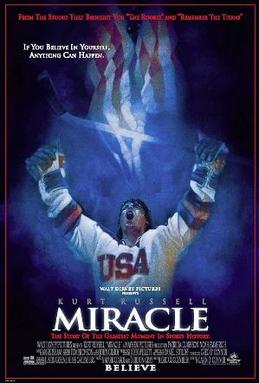
5) Miracle - Okay, another sports/history movie.  But, why not?  These stories are engaging. This is about the 1980 American men's hockey team defeating the Soviet Union, and later winning the gold medal.  All though the historical aspects are down played in the movie, the Cold War revival is there - and the other events weave their way into the story such as the American boycott of the 1980 summer Olympic games.
 

Then, to top it off, I have movie guides to go with all these movies.  Please feel free to check them out here.  Don't forget to click on the HISTORICAL MOVIE GUIDES tab in the upper left...

Also, if you are looking for the best Social Studies resources on the Internet, take a few minutes to check out the entire Social Studies SUPER store.


Wednesday, April 20, 2016

5 ENGAGING CIVIL RIGHTS INTERNET RESOURCES

Looking for virtual tours or primary source information about the Civil Rights Movement?  Then check out these resources.
 
  1.  This site gives students a virtual tour of Dr. King's childhood home.  Students will see where young Martin ate dinner, played board games, or where he slept. Each room includes interesting information about Dr. Kings' youth and his family.  Click here to take the virtual tours now: MLK's Childhood home.
  2. This educational resource allows students to view the 1955-57 Montgomery Bus Boycott from the perspective of a newspaper investigative reporter. Students are guided through a series of bus stops where they are given scenarios of the unfair treatment and conditions under which blacks during a bus ride in Montgomery, AL.  Click here to check it out: Bus Interactivity.
  3. The African American Museum of Iowa is a special, hidden resources.that few people know about.  The virtual museum is very user friendly.  Also this site has an outstanding list of African American resources.  Take time to explore and you will find many useful resources! African American Museum of Iowa.
  4. The Henry Ford Museum allows students to take a special peak at the famous Bus that Rosa Parks rode on.   The Ford Museum-Rosa Park Bus.
  5. This is PACKED full of primary sources such newspapers and oral histories.  The Birmingham Civil Rights Institute is one of the best places on the Internet to find classroom resources.  Click here to go directly to the Galley section to find these resources: Birmingham Civil Rights Institute-Gallery.  
Also, don't forget to visit the Social Studies Super Store to find the best Social Studies activities and lessons around.  Check it out right here- Social Studies Super Store.

Tuesday, January 5, 2016

Preparing for Martin Luther King Day

As I returned from Christmas break, my mind is pondering about our school's annual MLK Celebration.  It's a time when I try to make Dr. King's message relate to my student's life in a meaningful way.  To get my students understand, in a world so full of hated and yelling, that Dr. King's message is POWERFUL today.

To help me remember Dr. King's message I have been listening to his Methodist Student Leadership Conference Address.  Unlike his I Have A Dream speech, this speech is more lengthy.  So, I've been listening to it on my lunch breaks and on my prep.  Yes, more than once.

In this speech Dr King explains the success of the non-violence movement and the power of love. He explains why as a society we must care of each other.

Also, this speech addresses why I am a teacher (maybe you too).  Why it is important to help ALL my students succeed.  Why public education is so important to our society.  Finally, if you listen carefully to this speech, we can hear the whispers of the I Have A Dream Speech and his Mountain Top speech in this speech.

As a fellow educator, I know how busy your day is and how you have so much to accomplish...But take a few minutes and listen to this speech. MLK's Methodist Student Leadership Conference Address

Also, if you are looking for some engaging MLK Day lessons, check out the Social Studies Super Store.  Here is one lesson you might want to review.  MLK Lesson
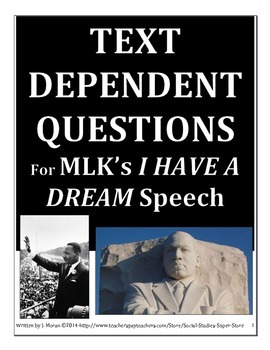
High School Common Core-Text Dependent Questions for MLK's

Saturday, December 12, 2015

Cartoons in the high school classroom? Really? YES!

Wait, just not any cartoon.  Rather, these are specific, educational cartoons.  One series comes to mind for US history teachers; Liberty's Kids.

These cartoons, originally aired on PBS and they follow three teenagers named Sara, James, and Henri as they muddle through the major historical events of the American Revolution.  These teens seem to bump into all the American history heavy hitters.  But, the creators of this cartoon easily weave the characters lives into real situations. 

But, what is even better is the content this cartoon series delivers.  For example in episode 23 James is captured by Hessian soldiers as he stumbles into the enemy hands.  But, the story easily dives deep into content as James discovers the not all Hessians are the same. As some of the "Hessians"are really  from Brunswick, and many were pressed into serve. If they refused, they would have been shot.  Meanwhile the same episode easily explores the frustration of General Benedict Arnold as he and General Gates clash.  Heavy and historically very deep for each cartoon is only 22 minutes in length!

Another example was episode 16, that explores the capture and the execution of Nathan Hale.  Yes, the same Nathan Hale who stated, "I only regret that I have but one life to lose for my country."  Again, the cartoons gets many of the historical details correct. Also the depth of information is amazing, while taking on the historical subjects tastefully.

So, I urge my American history colleagues to give this series an opportunity in your high school classes.  Added bonus: you can view these cartoons free online. 

Finally, to help keep students on track I have some awesome video guides.  All video guides include fill-in and short answer questions, key, teacher resources, and extension activities.  Each video guide is reasonably priced at $2.00 each.  The price drops if you purchase bundle packs.

Check them out at Video Guide #23  and Bundle pack 1 - 10,

Sunday, November 29, 2015

WANT TO SAVE MONEY AND MAKE YOUR JOB EASIER?

It's that time of the year when everybody is holding a sale....So is the Social Studies Super Store!  Today and tomorrow save up 28% on EVERYTHING! Yes, on all items, no limits!
Hurry before it's too late.  There is no better time to save and help your teaching become easier! Click here to see all items: Social Studies Super Store

Saturday, November 7, 2015

Multiple Intellgence and Authentic Assessment


This past week or so, I've been thinking about Multiple Intelligence (MI) and it occurred to me that so many of the actives dealing with MI fall under the authentic assessment.

Authentic assessment refers to assessment tasks that resemble reading and writing in the real world and in school (Hiebert, Valencia & Afflerbach, 1994; Wiggins, 1993). Its goal is to make a connection to actual situations to apply their knowledge.  Also, when students are given an authentic assessment, they are more engaged as they deal with a real world problem.  Examples of these activities might be creating a book, a journal, or even a campaign poster.

AN EXAMPLE:
One example of this included video productions.  Video production belongs to the Body Kinesthetic intelligence of the Multiple Intelligence.

This week, my students completed a video demonstrating their knowledge about women's' suffrage.  For this authentic assessment, the students are creating a video for Steven Spielberg.  Here are two examples of the students' work.  I hope it is clear they learned something, at the same time, had some fun too. :)


ASSESSMENT: 
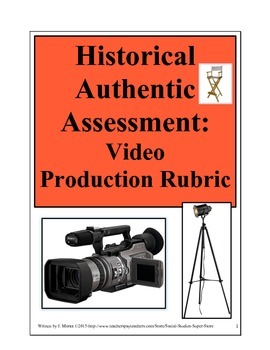
How do I grade this assignment?  I created this handy grading rubric.  If interesting in learning more about this rubric, you can review it at the Social Studies Super Store.
Historical Authentic Assessment: Video Production Rubric

Sunday, September 27, 2015

A Justification For More History in American Schools


A Justification For More History in American Schools

The small high school where I teach cut one year of American History from the district curriculum to make way for another math class.  Before the change students were required to successfully pass two years of American History.   American History A was completed by students in their sophomore year, and American History B was completed by students in their junior year.

Before the change it was perfect in so many ways.  With two years for American history, I had time to explore and teach in-depth of those important American documents such as the Declaration of Independence, and teach all the way to the conflicts in Iraq and Afghanistan.  I had two weeks to teach World War II, with time remaining for teaching the roots of the Vietnam War.  I had time for field trips to area museums and interview local veterans about their time in the service and historic conflicts.  Then, we had time to complete a research paper for the end of the semester, which students then presented to their peers. 

But with the short presentation by the superintendent and a quick vote by the school board, this changed.

Now, I have only one year to cover the same information.  So students do not have field trips, the veteran interviews have been deleted, and no term papers (yes, this broke my students’ hearts).  Now, the opportunity to deeply and richly explore issues and concepts are gone since students’ time has been hacked in half.

When I spoke with the powers that be, it was explained to me how important it was for our students take more math classes.  This, it was hoped, would raise our math scores. Yes, I agree, math is important, but isn’t history also important? 

I was told the school district had to raise the achievement levels in the area of math, and one possible solution to my dilemma might be for me to be more selective in what I teach in history.  In other words, skip entire subjects and teach only the most important subjects or concepts of American History.  This is easier said than done as History, and many other social studies classes have a unique situation; the curriculum continues to grow.

Here’s what I mean.  I started teaching in 1998.  Just think about all that has changed since 1998.  Bill Clinton was President, George Bush was just making sounds about running for president, the idea of having American troops in the Iraq and Afghanistan would sound crazy in 1998, the government was running a surplus in revenue, cell phones were just that, phones without cameras and other computing devices, people still bought their music at stores on CDs, and I kept my grades in a book, not on the computer.  In short, so much has changed in government, civics, society, and history.  But every year more is added to my subject of history.  So, what kind of education might my students receive if I stopped in the year 1998?

So if I had to skip some subject, then I would have to pick.  But there will be some losers and some winners.  And what is important for one year, might be kicked out since something more current and pressing emerges.  For example, during the late 90s, the balance budget amendment was huge news.  The amendment nearly passed the Senate and failed by one vote.  The one senator who did not support it was Senator Hatfield from Oregon – A Republican.  Today, who remember this?  Would this win out compared to the issue of homeland security today?  Also, what I believe is important, another history teacher may not deem as important.  Even with standards, there will be many holes.

Although I am not a math and English teacher, I do not see much changing in these curriculums every four or eights years.  Math intergrades are not voted out of office and the negative number take over.  And students do not need to understand the ramifications of the negative numbers upon the government.  These subjects do not grow exponentially as it does in History or other social studies area.

In short, social studies is unique for many reasons.  But one specific area that it is different is how it changes and more is added to the curriculum every year.  And, to pick and choose will create “holes” in students’ knowledge in the subject.   This is why more time is need in American schools for History and other social studies subject.

Wednesday, September 2, 2015

Japan's Formal Surrender - Primary Source


In honor of the ending of World War II I have included a link an an audio clip and transcript of Japan surrendering on the deck of the USS Missouri.  Today marks the anniversary of Japan's formal surrender.

Although World War II started in 1939 with Nazi Germany invading Poland, the United States did not join the war until December 7th as Japan attack Pearl Harbor, and other American installations in the Pacific.

After four long years of conflict, World War II ended on the USS Missiouri with General Douglas MacArthur presiding.

The Miller Link is an excellent opportunity for you share primary source material with your students. The Miller Center

Happy  Teaching!