Store Link

Fourth, Fifth, Sixth, Seventh, Eighth, Ninth, Tenth, Eleventh, Twelfth, Homeschooler, Staff - TeachersPayTeachers.com
Showing posts with label great teaching ideas. Show all posts

Saturday, December 5, 2015

differentiation instruction - as easy as 1-2-3!

So, I've received an email from a teacher that use my movie guides and they asked me to create some easy differentiation lessons for some of her students that struggle with multi-tasking or might struggle with keeping up with other students while using the movie guides.

I thought, "Hey, that's a great idea!"  But, then I thought there was nothing to create.  After all they already have everything with my movie guides.

So, every movie guide I create include the times when the questions or concept occurs in the movie/video.  But, this information is only located on the KEY.  This being the case, here is the first easy solution for differentiation for those students who struggle.

#1 - Simply write in the time next to the question appears in the video. 
From the Liberty's Kids Episode 16 Video Guide
#2  Easy solution- Write in the first letter of each answer in the blank of the statement.
From the Liberty's Kids Episode 18 Video Guide.


Here you can see how I include each letter for the each part of the answer.  For number three, the answer is General Washington.  So, I have written the letter G and W.

#3 Easy solution - If you look closely, you can see there are a few short answer questions on these video guides.  Short answer questions are important to keep the students engaged with the video. It moves them into thinking mode, from the "search and destroy" mode for answers.  When I have these, I make sure I stop the video so all the students will understand those important concepts.  But for those students who struggle to keep up, why not just hold a "one-on-one" with them.  A "one-on-one" is when you check for understanding and debrief the video with them.  Then, at this time, this is an excellent time review those short answer questions with them.

Thank you for your interest in my blog.  Please take a minute to check out the Social Studies Super Store: https://www.teacherspayteachers.com/Store/Social-Studies-Super-Store.

Friday, November 20, 2015

Movies Get the Brains Going....

When I first started teaching, I had an administrator who informed the staff that any video over 10 minutes can not be used in class.  The administrator was concerned about a teacher who turns the movie on and walks away.  Students have no interaction with the material and the movie has no context and quickly is only entertainment.

I agree.  For those of us who teach social studies, we have many, many opportunities to use movies in the class.  But we need to place the movie in context and keep the students engaged!

Here are 5 tips to achieve this!

#1.  Give the students something to do during the movie.  Every time I show a movie, students have a movie guide to complete.  Some times these movie guides include open ended questions, other times these are fill-in the blank questions.  This helps the stay focused on the key points.

#2.  Stop the movie.  I never allow the movie to run more than 15 minutes with stopping and asking students a question or discussing the significance of a scene. Key here is engagement.  Keep them focused with questions.

#3.  Eyes on the movie.  Sometimes when I show movies, students will ask me if they can lay in the floor, or bring their pillows into the class.  No way.  Remember, the movie is part of an assignment.  If a student thinks they lay down on the job, they might not be so willing to stay focused. 

#4:  Timing is everything!  Usually movies require more than one class period to show it in the entirety.  So, if I can help it, I stop the movie with five or ten minutes remaining in the class.  At this time I review the important points from the movie or gather students insights or opinions.

#5: What happens in the end?  Once the movie is completed I have students complete a concluding assessment.  Most of my movie guides include discussion questions and as a class we share our thoughts about these questions.  Other times, I have students draw a picture from what they believe is the most important scene from the movie.  Then they write a paragraph explaining their scene.

Here are a few movie guides I have used in my class.  Please feel free to check them out!

1) All Quite on the Western Front:  https://www.teacherspayteachers.com/Product/All-Quiet-On-The-Western-Front-Movie-Notes-1979-1598048.

2)  Unbroken: https://www.teacherspayteachers.com/Product/SECONDARY-Movie-Guide-UNBROKEN-1867758.

3) Thirteen Days: https://www.teacherspayteachers.com/Product/SecondaryThirteen-Days-Movie-Guide-and-Activity-1838519.

4) 42: The Jackie Robinson Story:  https://www.teacherspayteachers.com/Product/Movie-Guide-42-The-Jackie-Robinson-Story-1673058.


Wednesday, October 14, 2015

Multiple Intelligence...Useful or Not?


DOES MI WORK?
Lately there have been several studies that show little or no growth in students when teachers use Multiple Intelligence (MI) in the classroom.

I do not dispute these studies.  These students might not demonstrate any growth, or little growth.  But, are these studies looking at the glass of data as being half full?  What might have happened to those same students if the teachers did NOT implement Multiple Intelligence in the classroom.  Could these same students have fallen?

Don't get me wrong, I want all students to improve and rise the highest level. As an educator, we want to use best practices, and questioning practices is good.  But might these studies have left something out of the study of MI?  MI is so much more than having students complete assignments in different formats. 

WHAT IS MI?
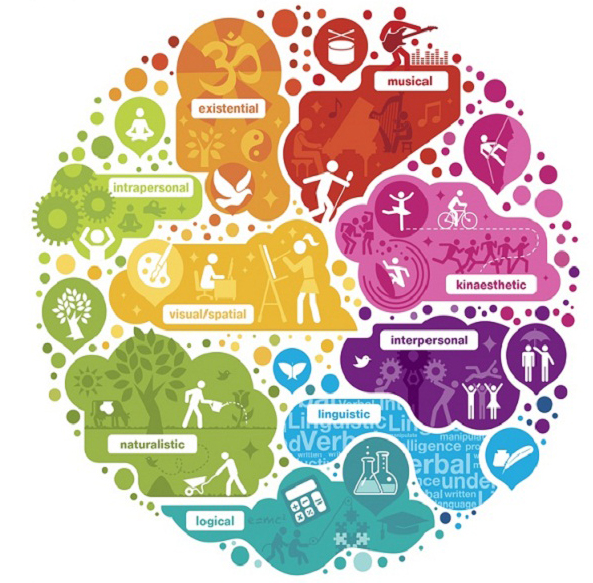
In a nut shell, MI is based upon the premise that "people employ several different types of intelligence, rather than one general type." Dr. Gardner created eight different kinds of learners, that include:
  • Linguistic
  • Logical.Mathematical
  • Visual/Spatial 
  • Musical
  • Bodily/Kinesthetic
  • Naturalistic
  • Interpersonal
  • Intrapersonal
Dr. Gardner believes all people can learn, but we learn best in our own way.  
As a classroom teacher, I have used MI to change my lessons based upon my students learning styles.  Many times, I have created different assignments for the same lesson.  Then I have given students options for the assignment.  For example some students might pick a poetry assignment, while others might complete the presentation assignment. When students have choices they feel empowered in their education.  Empowerment in education is a good thing!

THERE IS MORE!

But there is another side of MI which I think the studies missed; building of a community.  MI is built upon the foundation that ALL students can be successful learners.  All students in the classroom can learn in their own modality.  Some students are known to be the "artist", while other students might be known as the expert in figuring out puzzles, or another might be very good at writing poems.  Over time, the students in the class will learn who the "go to person" will be for a certain skill.  In short, MI builds upon the idea that all students can contribute to the community of learning in the classroom.

MI empowers students in other ways.  When students understand how their brains works, the begin to overcome their obstacles.  MI is a tool for students to discover their best method of learning.  Once students begin the journey of discovery of their own learning, they begin to take charge of the education.  This is a good thing!

NEED RESOURCES?
Please visit my store for many rubrics, projects, and assignments based upon MI. The Social Studies Super Store!

DO YOU WANT TO JOIN IN?

If you might want to learn more about MI, here are a few internet resources.